The Evolution of Early Excellence in Banjara Hills
The Evolution of Early Excellence in Banjara Hills
Oct 12, 2026
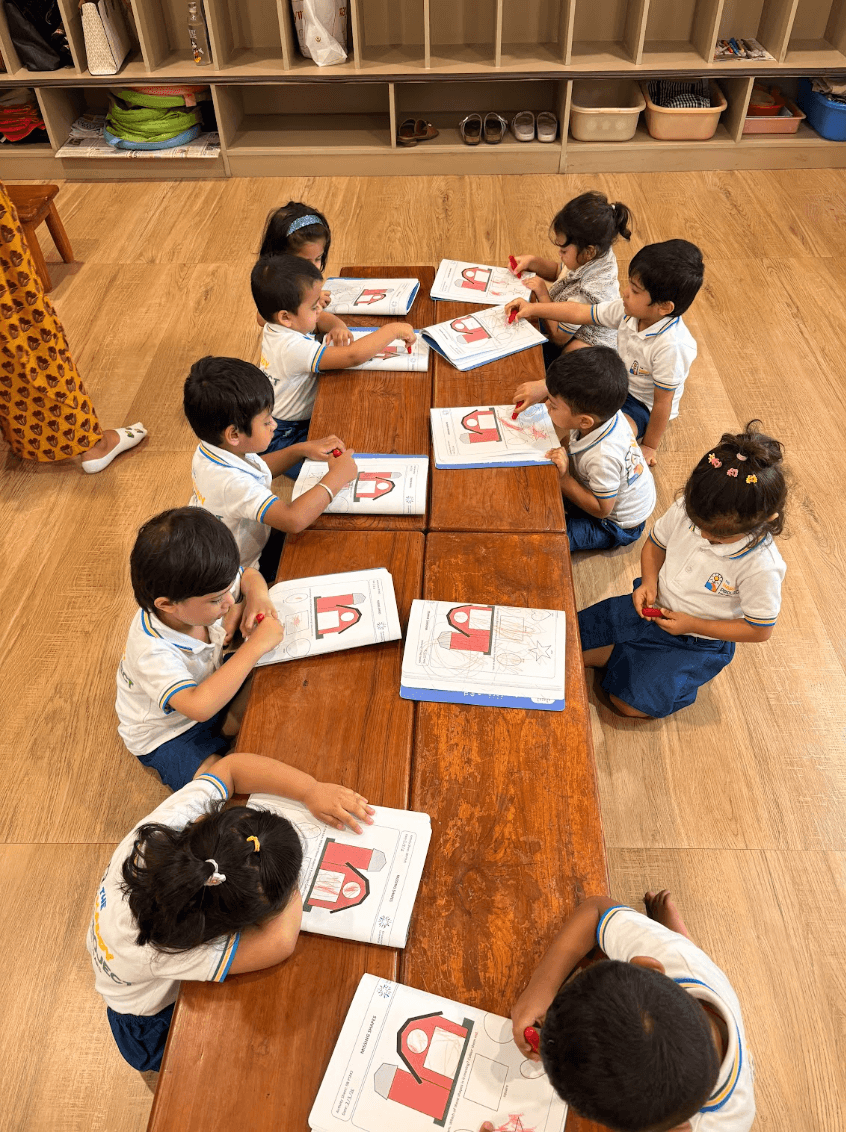
The conversations among parents at coffee mornings have changed. A decade ago, the question was which school had the strongest phonics program or the most impressive building. Today, among families in Banjara Hills and Jubilee Hills, the question is quieter and harder: will my child be able to handle disappointment, name what they feel, and walk into a room of strangers without shrinking?
Banjara Hills has long been the center of gravity for Hyderabad's most selective educational institutions, and that concentration has raised the baseline for everyone. But the ceiling has moved. The defining measure of a top preschool in Hyderabad is no longer the square footage of the campus — it is whether a three-year-old leaves each day more confident, more curious, and more capable of connection than they arrived.
For the 2026 academic year, emotional intelligence has become the primary differentiator between a good preschool and an exceptional one.
The signals are visible in how the strongest schools structure themselves. Sunshine Preschools maintains a teacher-child ratio of 1:10 for Playgroup and Nursery levels. Kidhood Banjara Hills limits its total preschool student capacity to 60 children to ensure focused care. Esperanza Preschool And Child Care maintains a total school strength of approximately 90 students. And a genuinely nurturing early learning environment combines 21 years of educational expertise with a focus on emotional intelligence — depth of experience paired with a modern understanding of how small children actually grow.
Why Teacher-Child Ratios Define the Quality of Care
Emotional safety is not an atmosphere a school can decorate into existence. It is built in thousands of small, specific moments: a teacher noticing that a child has gone quiet, kneeling to eye level, and asking the right question before the frustration becomes a meltdown. Those moments require an adult who has the bandwidth to see them.
This is where ratio stops being an administrative detail and becomes pedagogy. In a large-scale daycare model, an adult's attention is necessarily distributed toward logistics — headcounts, transitions, safety sweeps. In a boutique setting, the same adult has room to intervene socio-emotionally: to coach two children through a dispute over a toy instead of simply separating them, to name an emotion aloud so a child learns the vocabulary for it.
Quality Benchmark: The Happy Project Early Years Preschools maintains a teacher-child ratio of 1:10 for Playgroup and Nursery levels — a useful reference point when assessing any premium preschool in Hyderabad for 2026.
Total capacity matters for the same reason. Kidhood Banjara Hills limits its total preschool student capacity to 60 children to ensure focused care. A smaller overall population means fewer unfamiliar adults, more predictable routines, and a physical environment the staff can genuinely supervise rather than merely monitor.
The Role of Socio-Emotional Learning in 2026
For a three-to-five-year-old, socio-emotional learning is not a subject on a timetable. It is the daily practice of recognizing what one feels, reading what someone else feels, and choosing a response that works for both. At this age, the brain is wiring the circuitry for self-regulation and empathy — which is precisely why the window matters so much and why the quality of socio-emotional learning in Hyderabad preschools deserves scrutiny.
Interactive play zones are the laboratory where this happens. A sandpit with three children and two spades is a negotiation. A dramatic play corner is an exercise in perspective-taking. A block tower that collapses is a lesson in frustration tolerance that no worksheet can replicate.
What this produces, over time:
Self-regulation — the ability to pause between feeling and acting, the single strongest predictor of a settled transition into formal schooling.
Collaborative fluency — entering a group, contributing, and recovering gracefully when an idea is rejected.
Resilient curiosity — treating a failed attempt as information rather than as a verdict on one's ability.
A nurturing early learning environment combines 21 years of educational expertise with a focus on emotional intelligence. That balance is the hard part. Anyone can add a "feelings chart" to a wall. Weaving emotional literacy through a rigorous academic foundation — without diluting either — is the work of two decades of refinement.
Infrastructure vs. Intent: Beyond World-Class Facilities
Walk through five premium campuses in Banjara Hills and the facilities will begin to blur. Climate-controlled rooms, sanitized play equipment, surveillance, ergonomic furniture, bright libraries. These have become the entry fee for early childhood education in Banjara Hills, not the distinguishing feature. When every contender clears the same infrastructure bar, infrastructure stops being a decision criterion.
What separates schools is intent — the thinking that governs how the space gets used. A beautifully equipped room where children spend most of their day seated and directed produces a different child than a modest room where children are invited to test ideas, argue, build, and revise. The physical environment should be safe and stimulating, certainly, but stimulation without a curriculum that demands critical thinking is just noise with good lighting.
The most useful question during a campus tour is not "what do you have?" but "what happens here at 10:30 on a Tuesday?" Interactive play zones that children help reconfigure teach agency. Static classrooms, however well appointed, teach compliance. A school preparing children for the real world has to look, at least some of the time, like the real world: unpredictable, social, and full of problems worth solving.
Navigating the Choice: What Banjara Hills Parents Must Ask
Fee structures and brochures are the easiest things to compare and the least informative. The questions that actually reveal whether a school will serve your child are the ones that make the admissions team think before answering. Ask them during the tour, ideally while watching a class in session rather than sitting in an office.
Four questions worth asking:
How are your teachers trained to handle emotional conflict? Look for specifics — a named approach, ongoing professional development, a described protocol. Vague reassurance about "loving teachers" is not an answer.
What does a child's day look like between structured instruction and open-ended activity? You are testing whether creative, critical-thinking time is protected or whether it gets sacrificed whenever the academic schedule runs long.
How does the school involve parents in a child's socio-emotional progress? Strong programs report on self-regulation and peer relationships with the same seriousness they report on letter recognition.
What is the total school strength, and how is it distributed? For context, Esperanza Preschool And Child Care maintains a total school strength of approximately 90 students. A smaller population makes it far likelier that every adult on campus knows your child by name rather than by class list.
The Bottom Line: Selecting the Right Foundation
Choosing among the strongest contenders for the best preschool in Banjara Hills comes down to a short list of non-negotiables. Each of the following is observable on a single well-timed campus visit.
Longevity signals refinement. A school with two decades or more in the Hyderabad market has had time to discard what does not work. Ask how the curriculum has changed over that period — a program
The conversations among parents at coffee mornings have changed. A decade ago, the question was which school had the strongest phonics program or the most impressive building. Today, among families in Banjara Hills and Jubilee Hills, the question is quieter and harder: will my child be able to handle disappointment, name what they feel, and walk into a room of strangers without shrinking?
Banjara Hills has long been the center of gravity for Hyderabad's most selective educational institutions, and that concentration has raised the baseline for everyone. But the ceiling has moved. The defining measure of a top preschool in Hyderabad is no longer the square footage of the campus — it is whether a three-year-old leaves each day more confident, more curious, and more capable of connection than they arrived.
For the 2026 academic year, emotional intelligence has become the primary differentiator between a good preschool and an exceptional one.
The signals are visible in how the strongest schools structure themselves. Sunshine Preschools maintains a teacher-child ratio of 1:10 for Playgroup and Nursery levels. Kidhood Banjara Hills limits its total preschool student capacity to 60 children to ensure focused care. Esperanza Preschool And Child Care maintains a total school strength of approximately 90 students. And a genuinely nurturing early learning environment combines 21 years of educational expertise with a focus on emotional intelligence — depth of experience paired with a modern understanding of how small children actually grow.
Why Teacher-Child Ratios Define the Quality of Care
Emotional safety is not an atmosphere a school can decorate into existence. It is built in thousands of small, specific moments: a teacher noticing that a child has gone quiet, kneeling to eye level, and asking the right question before the frustration becomes a meltdown. Those moments require an adult who has the bandwidth to see them.
This is where ratio stops being an administrative detail and becomes pedagogy. In a large-scale daycare model, an adult's attention is necessarily distributed toward logistics — headcounts, transitions, safety sweeps. In a boutique setting, the same adult has room to intervene socio-emotionally: to coach two children through a dispute over a toy instead of simply separating them, to name an emotion aloud so a child learns the vocabulary for it.
Quality Benchmark: The Happy Project Early Years Preschools maintains a teacher-child ratio of 1:10 for Playgroup and Nursery levels — a useful reference point when assessing any premium preschool in Hyderabad for 2026.
Total capacity matters for the same reason. Kidhood Banjara Hills limits its total preschool student capacity to 60 children to ensure focused care. A smaller overall population means fewer unfamiliar adults, more predictable routines, and a physical environment the staff can genuinely supervise rather than merely monitor.
The Role of Socio-Emotional Learning in 2026
For a three-to-five-year-old, socio-emotional learning is not a subject on a timetable. It is the daily practice of recognizing what one feels, reading what someone else feels, and choosing a response that works for both. At this age, the brain is wiring the circuitry for self-regulation and empathy — which is precisely why the window matters so much and why the quality of socio-emotional learning in Hyderabad preschools deserves scrutiny.
Interactive play zones are the laboratory where this happens. A sandpit with three children and two spades is a negotiation. A dramatic play corner is an exercise in perspective-taking. A block tower that collapses is a lesson in frustration tolerance that no worksheet can replicate.
What this produces, over time:
Self-regulation — the ability to pause between feeling and acting, the single strongest predictor of a settled transition into formal schooling.
Collaborative fluency — entering a group, contributing, and recovering gracefully when an idea is rejected.
Resilient curiosity — treating a failed attempt as information rather than as a verdict on one's ability.
A nurturing early learning environment combines 21 years of educational expertise with a focus on emotional intelligence. That balance is the hard part. Anyone can add a "feelings chart" to a wall. Weaving emotional literacy through a rigorous academic foundation — without diluting either — is the work of two decades of refinement.
Infrastructure vs. Intent: Beyond World-Class Facilities
Walk through five premium campuses in Banjara Hills and the facilities will begin to blur. Climate-controlled rooms, sanitized play equipment, surveillance, ergonomic furniture, bright libraries. These have become the entry fee for early childhood education in Banjara Hills, not the distinguishing feature. When every contender clears the same infrastructure bar, infrastructure stops being a decision criterion.
What separates schools is intent — the thinking that governs how the space gets used. A beautifully equipped room where children spend most of their day seated and directed produces a different child than a modest room where children are invited to test ideas, argue, build, and revise. The physical environment should be safe and stimulating, certainly, but stimulation without a curriculum that demands critical thinking is just noise with good lighting.
The most useful question during a campus tour is not "what do you have?" but "what happens here at 10:30 on a Tuesday?" Interactive play zones that children help reconfigure teach agency. Static classrooms, however well appointed, teach compliance. A school preparing children for the real world has to look, at least some of the time, like the real world: unpredictable, social, and full of problems worth solving.
Navigating the Choice: What Banjara Hills Parents Must Ask
Fee structures and brochures are the easiest things to compare and the least informative. The questions that actually reveal whether a school will serve your child are the ones that make the admissions team think before answering. Ask them during the tour, ideally while watching a class in session rather than sitting in an office.
Four questions worth asking:
How are your teachers trained to handle emotional conflict? Look for specifics — a named approach, ongoing professional development, a described protocol. Vague reassurance about "loving teachers" is not an answer.
What does a child's day look like between structured instruction and open-ended activity? You are testing whether creative, critical-thinking time is protected or whether it gets sacrificed whenever the academic schedule runs long.
How does the school involve parents in a child's socio-emotional progress? Strong programs report on self-regulation and peer relationships with the same seriousness they report on letter recognition.
What is the total school strength, and how is it distributed? For context, Esperanza Preschool And Child Care maintains a total school strength of approximately 90 students. A smaller population makes it far likelier that every adult on campus knows your child by name rather than by class list.
The Bottom Line: Selecting the Right Foundation
Choosing among the strongest contenders for the best preschool in Banjara Hills comes down to a short list of non-negotiables. Each of the following is observable on a single well-timed campus visit.
Longevity signals refinement. A school with two decades or more in the Hyderabad market has had time to discard what does not work. Ask how the curriculum has changed over that period — a program
Say hello
8-2-348/2 & 8-2-348/2/A, Road No.3,Banjara hills,
Hyderabad, Telangana 500034
THE HAPPY PROJECT
Say hello
8-2-348/2 & 8-2-348/2/A, Road No.3,Banjara hills,
Hyderabad, Telangana 500034
THE HAPPY PROJECT
Say hello
8-2-348/2 & 8-2-348/2/A, Road No.3,Banjara hills,
Hyderabad, Telangana 500034
THE HAPPY PROJECT